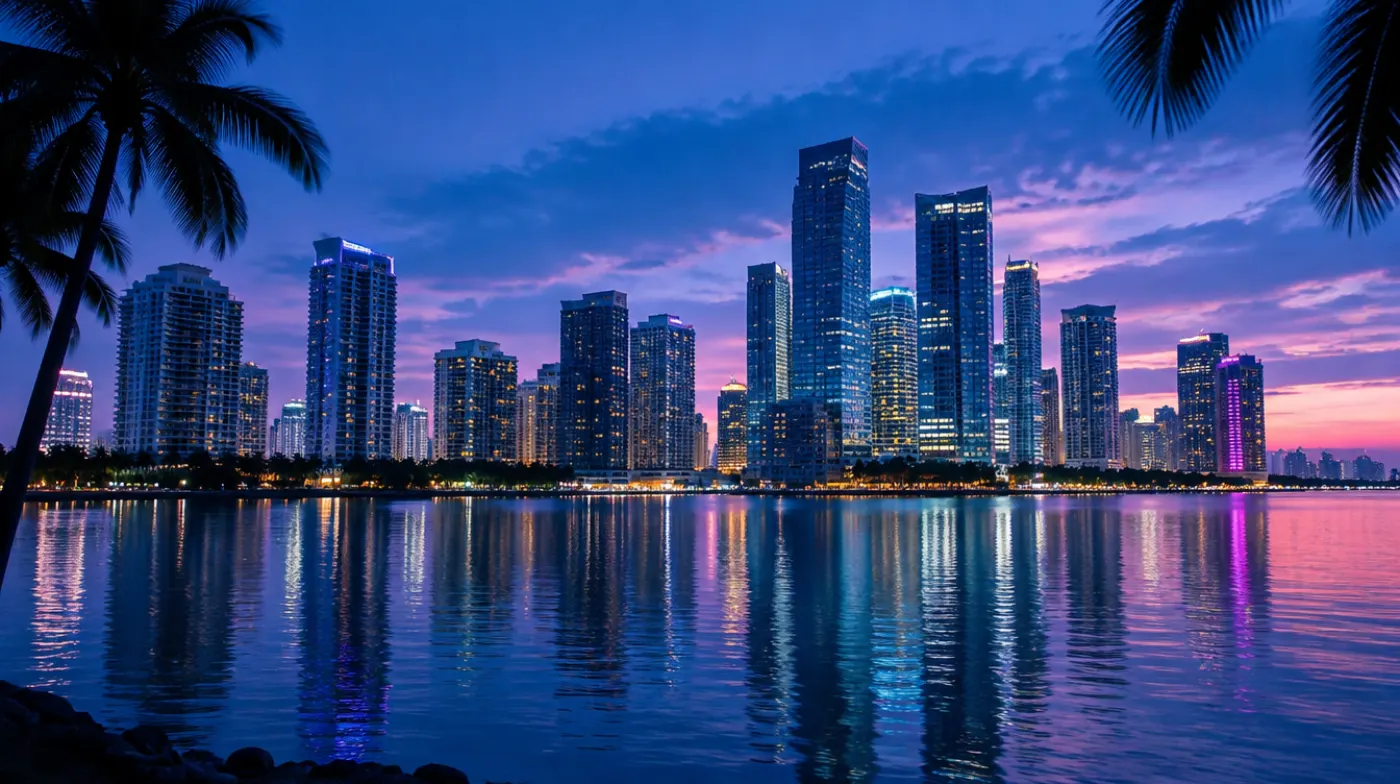
Miami is one of the most international real-estate markets in the United States. Buyers and renters arrive from Latin America, Europe, Canada and every other US state, drawn by climate, the absence of a state income tax, direct flights and a deep service economy. For investors who can only commit a small amount of capital, fractional structures can open the door to a market where a single condo often costs several hundred thousand dollars.
But Miami is also a market where the headline price is only part of the story. Insurance, association fees, special assessments and local rental rules can reshape the economics of a unit. This article walks through the main submarkets, the recurring costs that surprise newcomers, tax basics and the demand patterns behind short-term and mid-term stays. All numbers are illustrative.
Two very different submarkets: Brickell and the beach
Brickell and Downtown
Brickell is the city’s financial district and a dense cluster of high-rise condominiums. Its renter base is a mix of finance and technology professionals, relocating executives, business travellers and tourists who want an urban base. Because many buildings are relatively new and professionally managed, they tend to offer amenities such as pools, gyms, concierge and secured parking.
Strengths include year-round demand tied to business activity, walkability and proximity to Miami-Dade transit. Weaknesses include a very large pipeline of new towers, which can pressure rents, and building-level rules that often restrict rentals shorter than 30 days or require a minimum lease length of several months. The rental rules are often set in the condominium documents, so they differ building by building.
Miami Beach, South Beach and the barrier islands
Miami Beach is the classic tourist market: Art Deco hotels, the ocean, nightlife and events. Nightly rates can be high, especially in winter and during major events, but regulation is also stricter. Short-term rentals are limited in many residential zones, and enforcement has historically involved fines and licensing requirements. Some buildings, mainly those zoned for hotel or transient use, can operate legally at the nightly level, while others cannot.
Further north, Sunny Isles Beach, Bal Harbour and Surfside lean toward luxury and long-stay winter residents, often including “snowbirds” from the northern states and Canada, who rent for a month or more.
| Feature | Brickell / Downtown | Miami Beach / South Beach |
|---|---|---|
| Core demand | Business, relocation, urban leisure | Tourism, events, winter stays |
| Typical stay | 1 to 12 months, some shorter | Nights to weeks, where allowed |
| Regulation | Building-level minimum stays | City and zoning limits plus building rules |
| Seasonality | Moderate | Strong winter peak |
| Main cost pressure | HOA fees, insurance | HOA fees, insurance, flood exposure |
Demand drivers worth understanding
Several structural factors support Miami’s rental demand, though none are guaranteed to continue:
- Population and corporate migration. Since 2020 the metro area has attracted financial firms, funds and tech workers, supporting demand for housing and furnished rentals.
- Tourism volume. Greater Miami hosts tens of millions of visitors annually when overnight and day visitors are combined, with cruise traffic adding a further layer.
- International buyers and renters. Latin American demand in particular responds to local currency and political events, which can swing volumes.
- Events calendar. Art Basel, large sporting events and music festivals concentrate demand on a few weekends and push rates up sharply.
Against those, consider supply: new condominium towers keep opening, and a surge of units can weigh on rents and occupancy for a few years.
The cost stack that surprises newcomers
HOA and condominium fees
Most Miami condominiums charge monthly association fees that cover building insurance, common-area maintenance, security, amenities and reserves. For a mid-size one-bedroom in a full-service tower, monthly dues of several hundred to over a thousand dollars are not unusual. These fees are charged whether the unit is occupied or not.
After the 2021 Surfside building collapse, Florida tightened condominium laws. Associations are now required to complete structural integrity reserve studies and milestone inspections on older buildings, and to fund certain reserves more fully than before. The positive effect is greater building safety and transparency. The negative effect, for investors, is that many older buildings have raised monthly fees or issued special assessments, sometimes tens of thousands of dollars per unit, to catch up on deferred maintenance.
Insurance
Property insurance in Florida has become costly because of hurricane exposure, reinsurance prices and claim litigation history. Condominium owners typically carry an HO-6 policy for interior contents and improvements, while the association’s master policy covers the structure. Master policy premiums feed through to HOA fees. Flood insurance is separate, may be mandatory depending on the flood zone and mortgage status, and can be expensive for waterfront buildings.
A practical illustration: a unit with US$1,100 monthly HOA dues, US$250 monthly insurance and utilities share, and US$300 monthly property tax has fixed carrying costs of about US$1,650 per month, or US$19,800 per year, before cleaning, management or vacancy. If gross rent is US$34,000, those costs alone absorb nearly 60 percent.
In Miami, the question is rarely what a unit can earn on its best week. It is what the building costs on its worst year.
Property taxes and operating costs
Florida has no state personal income tax, but it does levy property tax set by local millage rates and assessed values, which can reset toward market value after a sale. Short-term rentals also usually involve state sales tax and county tourist development taxes on transient stays, which a licensed operator collects and remits. Add management, cleaning, furnishings, supplies and platform commissions.
Tax basics for investors
Tax treatment depends heavily on your residency and structure, so this is orientation only.
- US persons generally report rental income on federal returns, deduct allowable expenses and depreciation, and may owe state tax depending on where they live.
- Non-US investors investing in US real estate may face withholding on rental income, filing obligations and, when they sell, withholding under the Foreign Investment in Real Property Tax Act (FIRPTA). Estate-tax exposure on US-situs assets can also matter for non-residents with larger holdings.
- Fractional structures can add layers: the investor may hold an interest in an entity (such as an LLC or a trust-like vehicle) rather than the property itself, and the tax form received depends on that entity’s classification.
Official guidance is available from the Internal Revenue Service and the Florida Department of Revenue. A qualified tax adviser who understands both US rules and your home-country rules is worth the fee before investing.
Rental rules and legal context
Rules to check before evaluating any Miami unit:
- The condominium declaration and rules: minimum rental period, approval process for tenants, caps on the share of rented units and fees for move-ins.
- City or county ordinances on short-term rentals, including licensing and local business tax receipts.
- State licensing, where nightly rentals may require registration as a transient public lodging establishment.
- Mortgage and lender restrictions, if the building is financed.
A unit that is attractive on paper may be unusable for nightly stays if the association blocks them. Many investors therefore target buildings that explicitly allow short stays or choose a mid-term strategy of 30 to 90 days, which tends to reduce turnover costs and regulatory friction.
Why fractional access changes the picture but not the risks
Fractional ownership allows an investor to hold a small slice of a property, spread over multiple assets. It can help with diversification and entry cost. It does not alter hurricane exposure, building-level risk, insurance inflation or the fact that rent is paid only if the unit is occupied. When reviewing any Miami-based offering, ask:
- Which building and which submarket?
- Are short stays legally permitted there, in writing?
- What are current HOA dues, insurance cost and any pending or announced special assessments?
- Is there a reserve policy covering unexpected repairs and vacancy?
- What are the exit mechanics if you want to sell your fractions?
Climate, flood and resilience considerations
Miami sits at low elevation on a porous limestone base, and sea-level rise, tidal flooding and storm surge are discussed openly by local government and insurers. This matters for investors in two ways. First, the cost of insuring and hardening buildings is likely to keep rising, and those costs flow through HOA budgets. Second, buyers and lenders are becoming more attentive to elevation, flood-zone designation and building age, which can widen the price gap between resilient and exposed properties over time.
Practical checks include the flood-zone map designation for the specific parcel, the age and roof condition of the building, whether the garage and mechanical systems are above grade, the association’s hurricane-shutter and impact-window status, and the history of insurance claims. Newer towers built to the Florida Building Code’s high-wind provisions generally fare better than older mid-rise stock, though older buildings sometimes compensate with lower prices. None of this removes risk, but it helps convert a vague worry into questions with documented answers.
It is also sensible to model a bad year. If a major storm closes the building for six weeks, how much income is lost, which costs are covered by insurance and for how long does the deductible apply? A realistic stress test uses a hurricane deductible of 2 to 5 percent of the insured value, which on a shared master policy becomes a special assessment spread across all owners. Investors who plan around this scenario are rarely surprised by it.
Key takeaways
- Brickell offers business-driven, more stable demand, while Miami Beach has stronger tourism but tighter regulation.
- HOA dues, insurance and property tax can absorb a large share of gross rent, so verify them line by line.
- Post-Surfside rules improve safety but can trigger fee hikes and special assessments in older buildings.
- Tax treatment differs for US and non-US investors; get professional advice, especially on withholding and sale taxes.
- Fractional ownership lowers the entry ticket but does not remove market, insurance or regulatory risk.
This article is for educational purposes only and is not financial, legal or tax advice. Investments involve risk, including the possible loss of capital.